


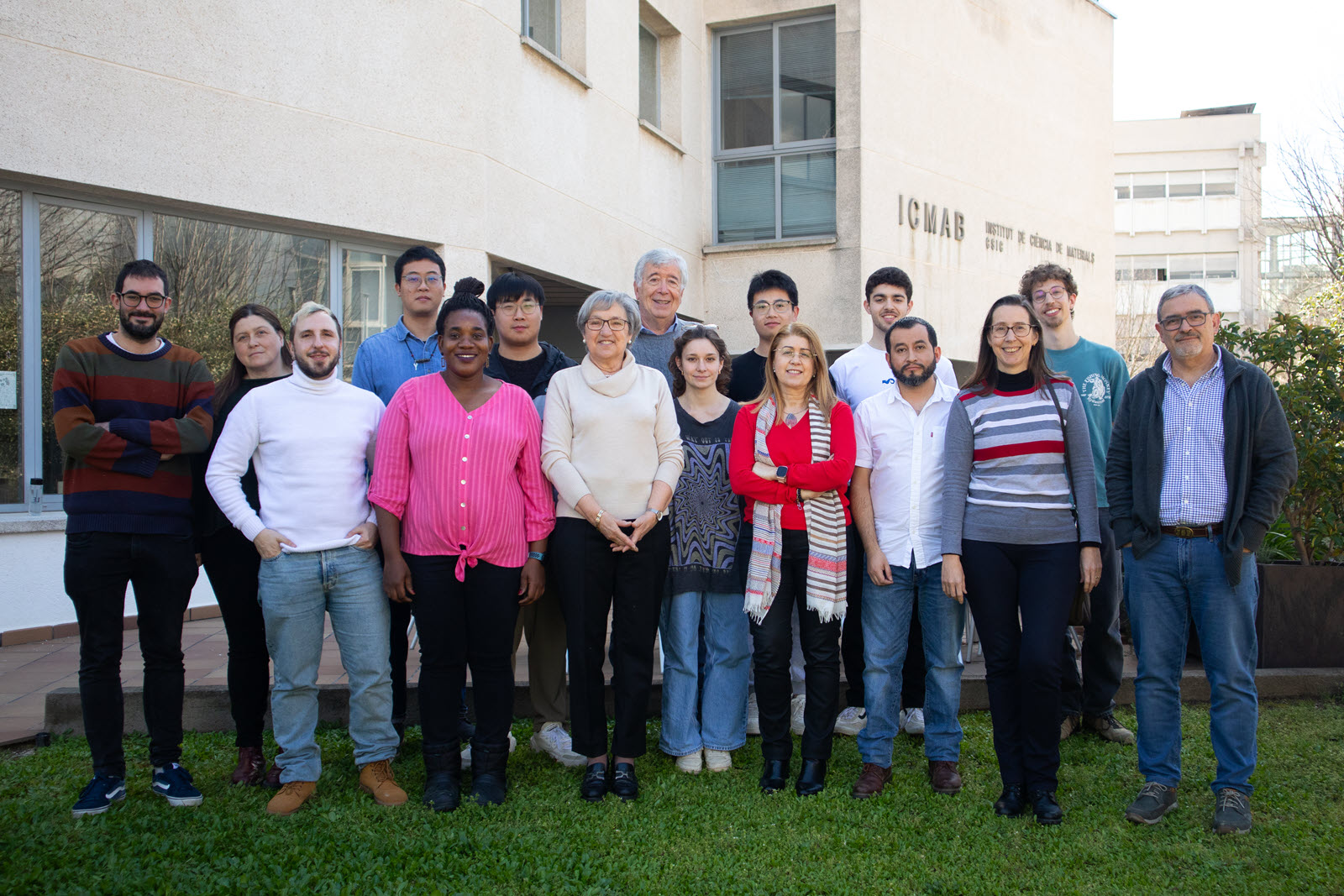
Boron cluster chemistry for functional materials and sustainable technologies
The Inorganic Materials & Catalysis (LMI) group is a dynamic team of chemists, physicists and materials scientists based at ICMAB-CSIC.
The group designs, modifies and explores the limits of boron cluster-based molecular and hybrid materials, connecting chemistry, physics, materials science and biomedicine.
Its research develops novel functional materials for socioeconomically important fields including sustainable energy, environmental protection, catalysis, optics, magnetism and medicine.
Research topics
Boron cluster-based fluorophores are an advanced class of luminescent materials that exploit the distinctive characteristics of boron clusters to achieve superior luminescence properties. Research by our group has significantly contributed to this field, highlighting the potential of boron clusters such as carboranes in enhancing fluorescence. Our studies have demonstrated that incorporating these boron clusters into fluorophores can lead to remarkable improvements in stability, emission tunability, and photophysical performance. For instance, our work has shown that boron cluster-based fluorophores exhibit increased resistance to aggregation-induced quenching, resulting in brighter and more durable fluorescence. Additionally, our research has revealed that the electronic structure of these boron clusters can be precisely tuned to achieve specific emission wavelengths and high quantum yields. These advancements are paving the way for applications in bioimaging, sensing, and optoelectronics, where the robust and tunable optical properties of boron cluster-based fluorophores offer significant advantages over traditional materials.
Solid-state light-emitting organic materials play a crucial role in various optoelectronic applications, such as OLEDs, solar cells, and fluorescence sensors. The o-carborane cluster is recognized as an exceptional aggregation-induced emission agent (AIEgen), promoting photoemission in aggregated or solid states. Recently, our group has developed carboranyl-containing fluorophores that exhibit remarkable AIE properties in solid forms and thin films, suitable for inkjet printing techniques. This advancement has led to the preparation of the first luminescent, water-dispersible nanoparticles based on carboranes. These findings motivate us to further explore this area, focusing on functionalizing different fluorophores with carboranes to develop new materials with enhanced photoluminescence properties for optical and biological applications.
Selected Papers:
- J. Mater. Chem. C, 2018, 6, 11336-11347
- Biomater. Sci. 2019, 7, 5324.
- Inorg. Chem. Front., 2020, 2370-2380.
- Dyes & Pigments, 2021, 194, Art. Number: 109644.
- Chem. Commun. 2022, 58, 4016. Inside Cover
- Chem. Mater. 2023, 35, 6979-6989
- Dalton Transactions, 2024, 53, 17841.
- Frontiers in Chemistry, 2024, 12:1485301.
Photosensitizers (PSs) are molecules that, when activated by visible light, produce reactive oxygen species (ROS), such as singlet oxygen (¹O₂), which are cytotoxic to cells. Among the most promising PSs for photodynamic therapy (PDT) are porphyrinoids and BODIPY-based fluorophores, known for their excellent properties and efficient ¹O₂ production. However, these molecules can aggregate through π-π stacking interactions, leading to decreased ¹O₂ generation. This challenge can be addressed by integrating 3D boron cluster structures with suitable organic fluorophores. Additionally, the enhanced lipophilicity of boron clusters improves cellular uptake, potentially boosting the effectiveness of PSs. Our research group is currently focused on developing novel boron cluster-based PSs for use as antibacterial and anticancer PDT agents.
Another class of PSs includes transition metal polypyridyl complexes. Our group has reported a set of Ru(II) and Ir(III) phenanthroline-based PSs with or without ortho-carborane clusters. These complexes exhibited cytotoxicity upon irradiation, indicating their potential as effective PSs for PDT. Remarkably, mono-carboranes complexes were the best internalised by the SKBR-3 cells, demonstrating the first examples of tris-bidentate transition metal-carborane complexes acting as triplet photosensitisers for PDT with a high photoactivity. Therefore, the high-boron content and the photoactive properties of these photosensitisers make them potential candidates as dual anti-cancer agents for PDT and Boron Neutron Capture Therapy (BNCT).
Recent research on boron cluster-BODIPY conjugates highlight their potent antimicrobial properties when are used as photosensitizers in antimicrobial photodynamic therapy (aPDT). Upon green light irradiation (around 545 nm), these iodinated hybrids generate reactive oxygen species, including triplet states, enabling strong bactericidal activity against multidrug-resistant Gram-positive bacteria like Staphylococcus aureus, Enterococcus faecium, and Enterococcus raffinosus. Notably, closo-dodecaborate derivatives achieve complete eradication of S. aureus at just 5 μM concentration, with no activity against Gram-negative strains due to their complex outer membranes, and negligible dark toxicity for enhanced safety. These boron clusters enhance water solubility, photostability, and biocompatibility of BODIPY scaffolds, addressing key limitations in traditional photosensitizers. Their potential lies in targeted disinfection for hospital infections, bridging inorganic chemistry with biocompatible agents for light-activated, environmentally friendly antimicrobial strategies resistant to bacterial adaptation. Future developments could expand efficacy to broader spectra and applications like anticancer therapy via boron neutron capture.
Selected Projects:
Fluorescent boron-cluster dyes as biocompatible photosensitizers with promising antimicrobial and anticarcinogenic activity
Funding body: European Horizon-MSCA-PF-2022, 165.312 €.
Duration: 16/01/2024 - 15/01/2026
PI: Dra. Rosario Núñez
Another promising class of PSs includes transition metal polypyridyl complexes. Our group has contributed to develope a series of Ru(II) and Ir(III) phenanthroline-based PSs, both with and without ortho-carborane clusters. These complexes have demonstrated significant cytotoxicity upon light activation, underscoring their potential as effective PSs for PDT. Notably, mono-carborane complexes showed the highest uptake in SKBR-3 cells, representing the first examples of tris-bidentate transition metal–carborane complexes functioning as triplet photosensitizers with strong photoactivity for PDT. The high boron content, combined with the photoactive properties of these PSs, positions them as promising candidates for dual-mode cancer treatment, with potential applications in both PDT and Boron Neutron Capture Therapy (BNCT).
Selected Papers:
- Bioconjug. Chem. 2018, 29, 1763.
- Biomater. Sci. 2021, 9, 5691.
- Dyes & Pigments 2024, 224, Art. Number 111985.
- ACS Omega, 2025, 10, 44693.
- Dyes & Pigments, 2026, 246, Art. Number 113362.
Metal-organic framework compounds (MOFs) represent a cutting-edge category of functional materials wherein metal ions or clusters are intricately linked by organic ligands, creating a three-dimensional network structure. MOFs are synthesized by combining metal-coordination geometries and ligands or linkers with the appropriate angular orientations. These metal-organic materials possess remarkable attributes such as a substantial surface area, customizable pore size and shape, and a diverse array of functional groups. These qualities render them highly versatile across numerous applications, including gas storage and separation, (photo)catalysis, sensing, and drug delivery.
In our group, we synthesize new 3D-Linkers based on icosahedral carborane clusters (C2B10H12) to prepare new MOFs and to study various aspects, ranging from their formation to their properties and stimuli-responsive behavior. The introduction of highly stable and hydrophobic carboranes into the MOFs confer unique properties to our materials:
Multi-metallic Multivariate MOFs
We pioneered a method to introduce up to eight different rare-earth (RE) cations into a MOF. This milestone was achieved thanks to the use of a 3D based car- borane linker, mCB-L = 1,7-di(4-carboxyphenyl)-1,7-dicarba- closo-dodecaborane, which proved to be essential for the incorporation of different-sized RE cations. Our innovative carborane-based approach enables the creation of multi-metallic MOFs with any desired combination of lanthanide ions, facilitating the synthesis of multifunctional materials with tailored properties, and the investigation of novel “compositionally complex materials” with unexplored phenomena.
Selected papers:
- J Mater Chem A 2024, 12 (33), 21971–21986.
- Adv Funct Mater 2023, 33 (47), 2307369.
- Chemistry of Materials 2022, 34 (10), 4795–4808.
Capture and degradation of toxic molecules in water
We reported, for the first time, the use of a thermal and hydrolytically stable MOF made of Zr(IV) and a tetracarbox- ylate carborane ligand, for the adsorption of GP and GF and biomimetic photodegradation of GP. These herbicides are of great concern owing to their indiscriminate use and negative impacts on human and environmental health.
Selected Papers:
- J Am Chem Soc 2023, 145 (25), 13730–13741.
Gas/liquid separation under humid conditions
Since 2016, we have pioneered the use of the carborane derivatives with the primary objective of increasing the water stability of the prepared MOFs. We have demonstrated that introducing carborane moieties into MOFs can greatly enhance the framework’s water stability. The high hydrophobicity of some of these MOFs has provided them with high hydrolytic stabilities that allow their use in applications where water is always present. That is the case of the adsorptive separation of CO2 under humid conditions or the efficient high-temperature butanol separation from a water (98%) acetone/butanol/ethanol (2%) mixture.
Selected Papers:
- ACS Appl Mater Interfaces 2023, 15 (4), 5309–5316.
- J Am Chem Soc 2020, 142 (18), 8299–8311.
- Angewandte Chemie International Edition 2016, 55 (52), 16049–16053.
Flexible metal-organic frameworks
By designing flexible carborane-based ligands, we have synthesized water-stable, soft porous crystals that function as crystalline sponges for a variety of guest molecules. Additionally, we have demonstrated, for the first time, an unexpected dynamic behavior in third-generation metal-organic frameworks (MOFs).
Selected Papers:
- Advanced Materials 2018, 30 (29), 1800726.
- Cryst Growth Des 2017, 17 (2), 846–857.
In an era where environmental sustainability and efficiency are critical to the advancement of chemical processes, photoredox catalysis has emerged as a transformative technique that promises to reshape the landscape of organic synthesis. By leveraging the unique properties of light and the electropositive nature of boron, this innovative approach allows for the activation of substrates in a manner that is both rapid and environmentally friendly.
Traditionally, photoredox catalysis has relied on second- and third-row transition metals, which facilitate charge separation through metal-to-ligand charge transfer (MLCT). However, our research, conducted in laboratories at ICMAB and the University of Girona (UdG), has broken new ground by employing first-row transition metals, particularly cobalt (Co) and iron (Fe), in conjunction with boron-based units to create a robust molecule that serves as a catalytic system. This molecule exhibits exceptional resilience against chemical attack, temperature fluctuations, and pressure changes. This strategic shift not only enhances the availability of catalytic materials but also reduces costs and improves sustainability, aligning with the vision of SunOx, the company we aim to establish for these applications.
The catalysts we utilize, θ-metallacarboranes, specifically θ-cobalta bisdicarbollide and θ-ferrabisdicarbollide, are remarkable in their structure, consisting of two icosahedra fused at a common vertex where the metal resides. This unique architecture contributes to their surfactant-like behavior, enabling the formation of micelles and vesicles that optimize substrate interactions and enhance reaction efficiency. Furthermore, these compounds exhibit well-defined electrochemical properties, allowing for reversible electron transfer processes that are crucial for effective catalytic cycles. In particular, cobalt demonstrates a substantial 3 V potential window between consecutive redox pairs, facilitating the efficient oxidation of various substrates. Although these θ-metallacarboranes capture light, one of the standout features of this photoredox system is its non-luminescent nature. This characteristic ensures that the energy absorbed from light is effectively channeled into chemical transformations rather than dissipated as light, leading to high chemical yields. Additionally, the requirement for water as a solvent not only aligns with green chemistry principles but also enhances the sustainability of our processes. Operating at low concentrations, ranging from 1:10,000 to 1:40,000, our catalysts can be easily immobilized on common supports, allowing for their recovery and reuse.
Through our research, we have successfully applied photoredox catalysis to the oxidation of alcohols, alkenes, alkanes, and benzene derivatives, achieving high yields in a clean and efficient manner. This advancement signifies a major step forward in developing synthetic methodologies that are both efficient and respectful of the environment. As we look to the future, photoredox catalysis stands at the forefront of chemical innovation, embodying the synergy between cutting-edge science, boron chemistry, and environmental responsibility. Together, we can illuminate the path to a more sustainable and efficient world of chemistry, where the power of light and boron drives transformative change in the synthesis of valuable chemical compounds.
Join us in embracing this exciting journey toward a greener future, leading to highly productive and sustainable chemical synthesis in the chemical industry!
Selected projects:
Green Transformation: Biogas to Methanol, an Ecological and Sustainable Route
(ACC_2023_EXP_SIA002_40_0002222 and ACC_2023_EXP_SIA002_20_0001449).
Type of project: SIDER, Desenvolupament Rural, Ayudas a las Actividades de Demostración Colaborativas de transferencia del conocimiento (intervención 7201), en el marco del plan estratégico de la PAC 2023-2027.
Funding body: Government of Catalonia and Spanish Ministry of Agriculture, Fisheries and Food, co-funded by the European Union., 99.980,71 €
Duration: 01/06/2024 – 31/05/202
Principal Investigators: Dr Rosario Núñez (ICMAB-CSIC); Dr M. Isabel Romero (University of Girona).
Green Phenol: One-Step Phenol Production.
Type of project: Impulsa-T Converge Programme
Funding: CSIC, 50,000 €.
Duration: 01/01/2024 – 31/12/2024.
Principal Investigator: Dr Rosario Núñez.
Valorisation of animal fat waste through sustainable photoredox catalysis (PDC2021-121183-I00).
Type of project: Proof of Concept.
Funding body: MCIIN/AEI/10.13039/501100011033; 109,000 €.
Duration: 01/12/2021 – 31/01/2024.
Principal Investigator: Dr Rosario Núñez
Selected papers:
- Cell Reports Physical Science 2025, 6, 102815.
- Book chapter: Advances in the catalytic and photocatalytic behavior of carborane derived metal complexes in Advances in Catalysis. Advances in the Synthesis and Catalitic Application of Boron Clusters: A tribute to the works of Professor Francesc Teixidor and Clara Viñas. Francesc Teixidor, Clara Viñas, José Giner Planas, Isabel Romero, Rosario Núñez, 2022, 71, 1-43 . ISBN: 9780323988315. SSN 0360-0564. Eds. Montserrat Diéguez and Rosario Núñez. Elsevier Inc.
Patents:
- Process for the photocatalytic oxidation of alkanes and aromatic hydrocarbons (WO 2024/251660 A1).
Inventors: Francesc Teixidor, Clara Viñas, M. Isabel Romero, Rosario Núñez, Isabel Guerrero.
Application Date: 03/06/2024


Our paper was ranked within the top 10% of most-viewed papers published by the journal among work published in Advanced Functional Materials between January 1, 2023 - December 31, 2023, up to 12 months after publication.

Permanent Scientific Researchers


Postdoctoral Researchers and Visiting Professors


PhD Candidates


Bachelor's and Master's students

Jaume i Masferrer, Abel

Rodríguez Souto, Judith
Technicians and Project Managers
Former Members

Li, Xiao-Bao

Sinha, Sohini

Li, Zhen

Soldevila Sanmartín, Joan

Gan, Lei

Tan, Fangchang

Chaari, Mahdi

Cabrera González, Justo

Tsang, Min Ying (Ivy)
Funding


- Exploring the uniqueness of icosahedral boron clusters for advanced materials (EUBorAM) Ministerio de Ciencia y Universidades
PID2022-136892NB-I00 (187.500 EUR)
01/09/2023-31/08/2026
Principal Investigators: Dr. Rosario Núñez and José Giner Planas - Fluorescent boron-cluster dyes as biocompatible photosensitizers with promising antimicrobial and anticarcinogenic activity
European Horizon-MSCA-PF-2022
(165.312 EUR)
16/01/2024-15/01/2026
Principal Investigator: Dr. Rosario Núñez - Transformació verda: biogàs a metanol, una via ecològica i sostenible Departament d’Agricultura, Ramaderia, Pesca i Alimentació, Generalitat de Catalunya
ACC_2023_EXP_SIA002_40_0002222(99.980 EUR)
01/06/2024-31/05/2026
Principal Investigator: Dr. Rosario Núñez - Green Phenol: one-step phenol production CSIC's Impulsa-T Program
(50.000 EUR)
01/01/2024-31/06/2026
Principal Investigator: Dr. Rosario Núñez - Grupo de Investigación consolidado en el marco del III Pla de Recerca de Catalunya Generalitat de Cataluña
2021/SGR/00442 (40.000 EUR)
2023-2025
Principal Investigator: Dr. Rosario Núñez - Espectrofotómetro modular de fluorescencia (UV-VIS-NIR) de alta sensibilidad, equipado para la determinación de tiempos de vida de fluorescencia hasta el rango de picosegundos y la detección de luminiscencia circularmente polarizada (CPL) EQC2024 de la Agencia Estatal de Investigación (AEI, Ministerio de Ciencia, Innovación y Universidades) (150.000 EUR)
2025
Principal Investigator: Dr. Rosario Núñez - Proyectos Prueba de Concepto “Valorización de Residuos de grasa animal mediante catálisis fotoredox sostenible”MCIIN/AEI01/12/2021-31/01/2024
PDC2021-121183-I00 (109.000 EUR)
Principal Investigator: Dr. Rosario Núñez - Materiales basados en clústeres boro para energía sostenible y aplicaciones medioambientales 2 AIE-MICIIN
PID2019-106832RB-I00 (120.000 EUR)
01/06/2020-28/02/2024
Principal Investigators: Prof. Clara Viñas and Dr. Rosario Núñez