


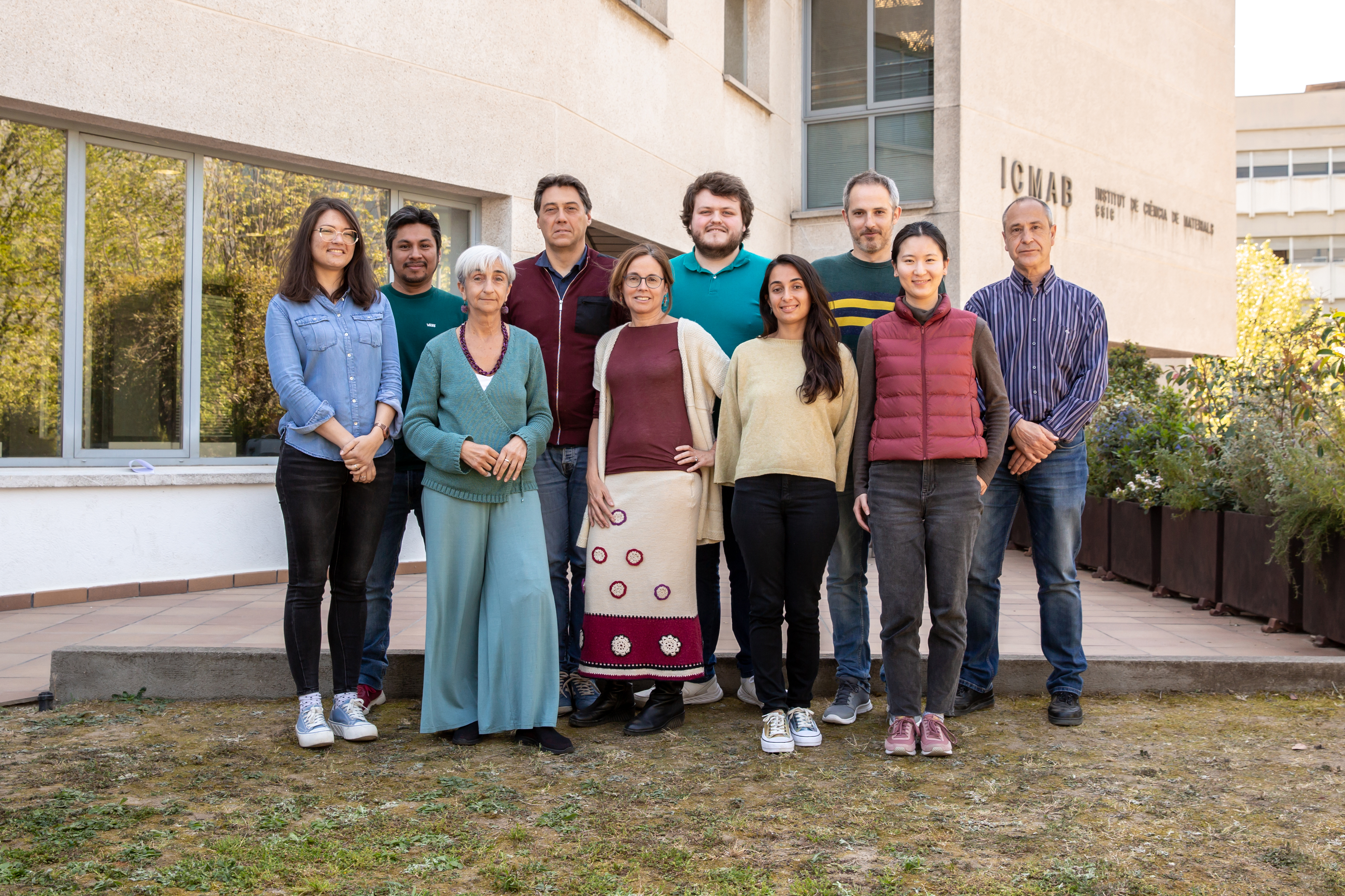
Physical Chemistry of Surfaces and Interfaces (SURFACES)
Surface engineering, organic thin films, nanoscale interfaces and scanning probe microscopy for understanding structural and electronic properties at surfaces and devices.
Surface engineering for organic materials and nanoscale interfaces
The Physical Chemistry of Surfaces and Interfaces (SURFACES) group focuses on unraveling and controlling the nanoscale structural and electronic properties of nanostructures and interfaces through surface engineering.
Devoting special effort to organic materials, the group investigates organic semiconductors with relevance as active layers for electronic devices such as organic solar cells and organic field-effect transistors.
Its research connects organic growth, surface functionalization, nanoscale electrical properties and the electronic response of metal-organic junctions within the ICMAB advanced materials ecosystem.
Research challenges
SURFACES addresses the chemistry, structure and electronic behaviour of surfaces and interfaces where materials functionality is created, modified and controlled.
Surface engineering
Organic thin films
Nanoscale interfaces
Advanced SPM methods
Main research lines
The group works across complementary research lines linking surface chemistry, organic materials, nanoscale electrical properties and advanced scanning probe microscopy.
Development of new SPM modes based in multifrequency dynamic Atomic Force Microscopy (AFM) to study wetting, ice nucleation and identification of chemical groups at the nanoscale. (AV)
Growth of organic ultra-thin films and chemical functionalization of surfaces (EB, CO)
Nanoscale electrical and structural properties of organic/electrode interfaces investigated by SPM (EB, CO)
Organic/organic heterojunctions and nanoscale electrical properties of organic electronic devices (EB, CO)
Study of ice nucleation on surfaces focusing on the effect of surfaces on heterogeneous nucleation and ice growth at ambient conditions. (AV)
Study of the interaction of water with ferroelectric surfaces and its role in surface charge screening using SPM and AP-XPS techniques.
Materials, methods and scientific approach
SURFACES combines surface physical chemistry, organic materials growth, chemical functionalization and nanoscale characterization to understand how interfaces determine material and device behaviour.
The group studies ultrathin organic layers, organic/organic heterojunctions, organic/electrode interfaces, ferroelectric surfaces and water-surface interactions using advanced scanning probe microscopy and complementary surface-sensitive techniques.
Scanning probe microscopy
Organic semiconductor interfaces
Surface functionalization
Water and ice at surfaces
People
Scientific researchers, postdoctoral researchers, technicians and project managers associated with the SURFACES research group.
Permanent Scientific Researchers
Postdoctoral Researchers
Technicians and Project Managers
Connected to the ICMAB research ecosystem
SURFACES contributes to ICMAB’s materials science ecosystem through expertise in surface chemistry, nanoscale characterization, organic semiconductors and functional interfaces.
Research Groups
Research Units
Scientific & Technical Services
Contact and group website
For detailed information about SURFACES research activity, current projects, publications and opportunities, visit the external group website or contact the group through the corresponding ICMAB channels.
Physical Chemistry of Surfaces and Interfaces
Surface engineering, organic semiconductors, ultrathin films, organic/electrode interfaces, SPM methods, wetting, ice nucleation and ferroelectric surfaces.

